Some links in this guide are affiliate links. If you buy through them we may earn a small commission at no extra cost to you. It never changes what we recommend.
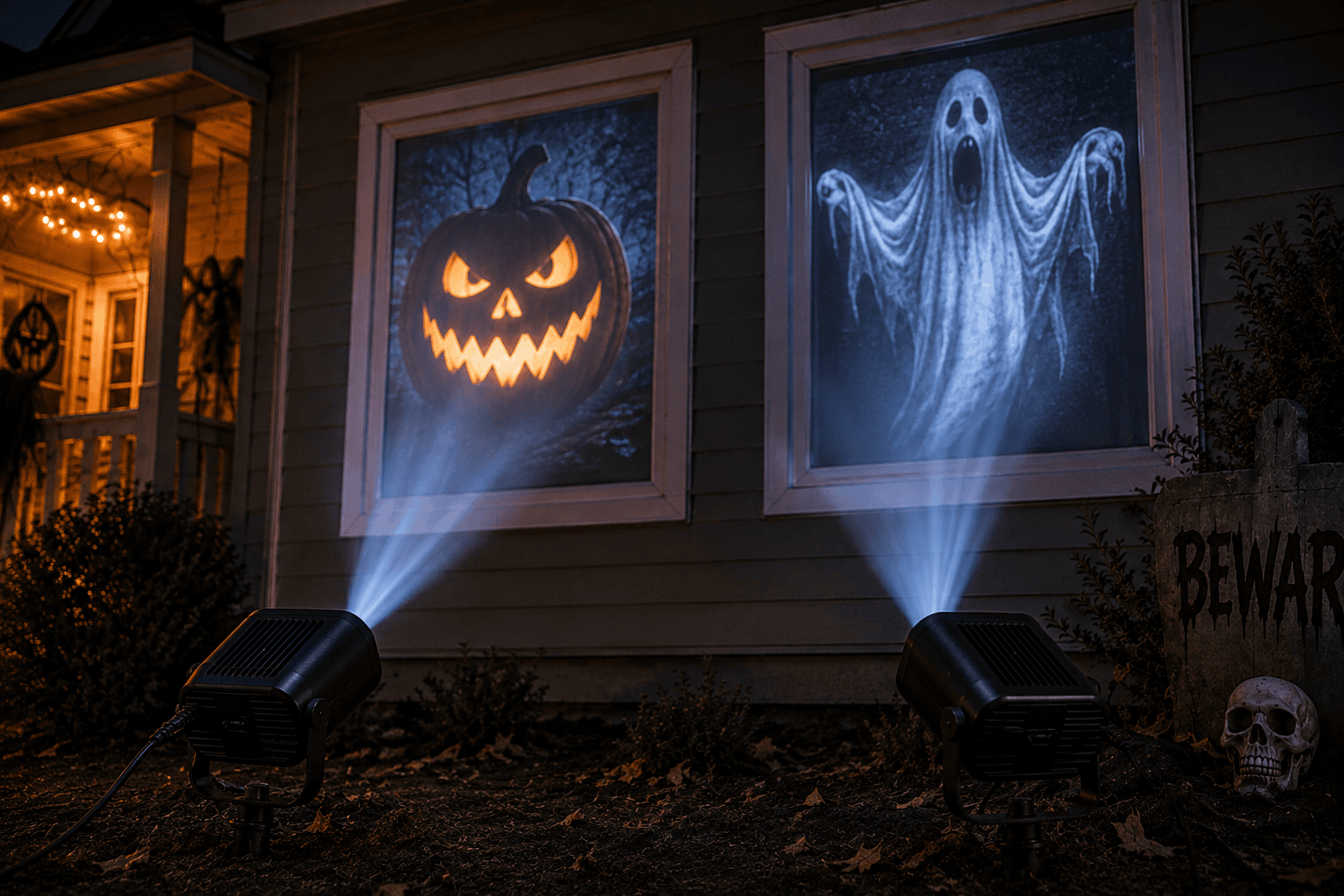
A projector is how you put ghosts in your windows and faces on your walls, and done right it is the effect that stops cars. A figure moving behind an upstairs window, a pumpkin that talks, spirits drifting across the side of the house. None of it is a physical prop, all of it is light, and that is exactly why it works. There is nothing for a passerby to explain away. But Halloween projection is also where people waste the most money, because there are two completely different things being sold under the same word, and buying the wrong one gets you a fuzzy blob instead of a haunting.
This guide sorts out what you are actually buying, what you need to make the good version work, and the specific gear worth the money this year.
The two kinds of Halloween projector, and why it matters
The word projector covers two very different products, and the gap between them is the whole game.
The first is a cheap LED pattern projector, the twenty to forty dollar kind that casts a spinning image on your wall, a red skull, a field of moving spiders, a swirl of ghosts. These are fine for ambiance. Stake one in the yard and it throws a themed pattern across the front of the house. What it does not do is create the illusion of something real. It is a decoration that projects a picture, and everyone can tell it is a projected picture.
The second is a real projection system, the kind that makes a spirit appear to move inside your window. That takes three things working together: a projector bright enough to be seen, animated video content made for the effect, and a screen material that catches the light while staying nearly invisible. Get all three right and people genuinely do a double take. This is the effect worth chasing, and it is what the rest of this guide is about.
What you need for the window-projection effect
The illusion has three parts, and each one matters.
The content is the part that actually sells it, and it is where most homemade attempts fall flat. Random Halloween clips look like random Halloween clips. Purpose-built digital decorations look like haunted windows. AtmosFX is the standard here, and has been for years. Their library of animated decorations is designed specifically to be projected onto windows, walls, and props, with characters framed and looped for exactly this use. Their 2026 Premium Club has been running at around $25 and bundles a set of decorations, which is the cheapest way into good content. You load their video onto a USB stick or a media player and the projector plays it on a loop all night. The content is a bigger factor in whether this looks good than the projector itself.
The projector needs to be bright enough to fight ambient light. A dim projector washes out against streetlights and porch lights, so you want reasonable brightness and at least 720p resolution, and you set it up in the darkest window you have. The good news is you do not need an expensive home-theater projector. Plenty of inexpensive 720p LED projectors with a wide-angle lens are made for exactly this, and several are sold bundled with AtmosFX content and a screen.
The screen material is what turns a video into a hologram. Projecting straight onto glass works but looks like a video playing in a window. A dedicated rear-projection material, like AtmosFX’s Hollusion or the Reaper Brothers translucent screens, captures the light and lets the dark areas disappear, which is what creates the floating, three-dimensional look. You hang the material behind the window or in the doorway and project onto it from inside.
Easiest path: an all-in-one Hollusion kit
If you want the real effect with no guesswork, buy a kit that bundles all three pieces. The Reaper Brothers and HoliScapes Halloween Hollusion kits pair an HD projector with sound and a remote, a large holographic rear-projection screen (commonly around 5.5 by 9 feet, sized for a window or door), and a set of AtmosFX video effects on a USB stick. Kits like these run in the low-to-mid hundreds depending on the screen size and content pack, and they exist precisely so you do not have to source a compatible projector, screen, and content separately and hope they work together.
This is the pick for anyone who wants the window-ghost effect this weekend without becoming an expert. Hang the screen, plug in the projector six to eight feet back, insert the USB, and you are done. The main knock on these kits is that the bundled projector is basic, but for window projection basic is genuinely enough, because the effect lives in the content and the screen, not in projector specs.
Cheaper path: buy the pieces separately
If you already own a projector, or you want to spend less, buy the pieces on their own. Get an inexpensive 720p LED projector with a wide-angle lens, buy AtmosFX content directly (the Premium Club or individual decorations like Ghostly Apparitions or the Jack-O’-Lantern Jamboree), and handle the screen yourself.
The screen is where you can really save. A dedicated Hollusion screen looks best, but home haunters have gotten convincing results for years with a frosted shower curtain, or with grey power mesh or chiffon fabric hung in the window. These materials catch projected light while staying translucent, and at a few dollars they cost a fraction of a branded screen. The trade-off is a bit more fiddling to get the brightness and framing right, and a slightly less crisp result than purpose-made material. For a lot of people that trade is well worth the savings.
Where the cheap pattern projectors fit
The twenty-dollar LED projectors are not a scam, they are just a different tool. A moving-spider or red-skull projector thrown across the whole front of the house adds motion and color to a display for almost nothing, and used as background ambiance alongside real props it pulls its weight. Just do not buy one expecting the window-ghost illusion, because that is not what it does. Think of them as animated wash lighting, not as the centerpiece.
Setup: getting it to actually look good
The gear only works if you set it up for the conditions, and projection is fussier than most Halloween decor.
Darkness is everything. A projector fights every competing light source, so the effect that looks incredible at 9 p.m. can look washed out at dusk. Pick your darkest window, turn off the porch light near it, and accept that projection is a full-dark effect.
Get the distance and angle right. Most of these projectors want to sit roughly six to eight feet back from the screen, projecting straight on rather than at a steep angle, which keeps the image from distorting into a keystone shape. Give yourself a table or shelf at the right distance inside the room.
Protect the projector from weather. The cleanest setup keeps the projector indoors firing out through a window, which also keeps it dry and quiet. If you must put a projector outside, house it in a weatherproof enclosure and keep it off the ground, because these are electronics and October is wet.
Match orientation to the content. Window decorations are usually made to be projected in a specific orientation, so check whether your scene is horizontal or vertical and frame the screen to fit. A tall ghost scene squeezed into a wide window loses the effect.
What to actually buy
If you want the real window-projection effect and you want it to just work, buy an all-in-one Hollusion kit with a projector, a rear-projection screen, and AtmosFX content included. It is the shortcut past the compatibility guesswork and it delivers the effect that stops traffic. If you already have a projector or you like tinkering, buy AtmosFX content directly, pair it with a cheap 720p projector, and make your own screen from a frosted shower curtain or grey mesh for a few dollars.
The one rule that saves you from disappointment: spend on the content and the screen before you spend on the projector. A basic projector with great AtmosFX content and proper screen material looks haunted. An expensive projector playing random clips on bare glass looks like a television in a window. And if you only want color and motion across the house rather than a ghost in the glass, a cheap pattern projector does that job for the price of a pizza. Projection is the showstopper, but it lands hardest on top of a display that already has its animatronics, fog, and lighting working together.